Diamond Stud Size Chart: How Big Each Carat Weight Looks
Stud sizes are often described by the combined weight of both diamonds. Here is how each carat total weight looks on the ear, and where you can spend less without seeing the difference.
Written by Love & Carat, with AI assistance, from the sources listed below. How we write
In This Guide (10)
- What Carat Total Weight Means for a Pair
- Diamond Stud Size Chart: How Each Weight Looks on the Ear
- Which Grades Matter Less in Earrings Than in a Ring
- Budget Bands in Words
- How to Match Two Stones into a Pair
- Settings and Backs: What Holds Them Secure
- Giving Diamond Studs as a Gift
- What to Ask Before You Buy
- Questions
- Sources
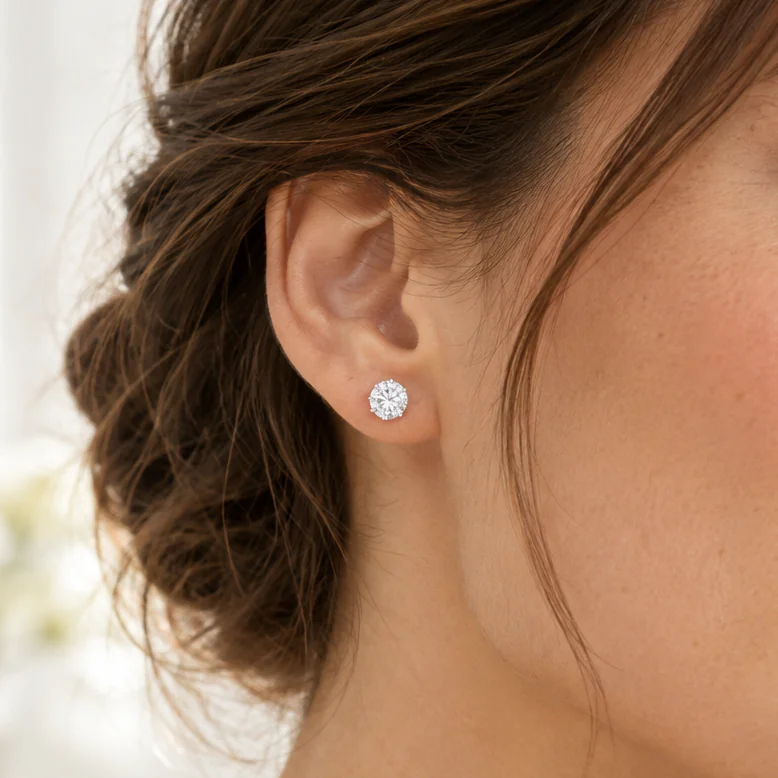
If a pair is described as 1 ctw, check the individual weights: a matched pair will have two diamonds of about 0.50 ct each. On the ear, about half a carat total reads as a small, quiet sparkle. A pair of 1 to 1.5 ctw is our usual suggestion for everyday wear, and 2 ctw and up reads as a statement. Earrings forgive lower clarity and color than a ring does, so more of the budget can go into size and cut.
What Carat Total Weight Means for a Pair
A carat is a unit of weight, not size: one carat is equal to 200 milligrams, and each carat is split into 100 points. GIA defines total carat weight as the combined weight of all the diamonds in a piece. For earrings you'll usually see it written "ctw" or "tcw".
For a pair of studs, that means:
- 1 ctw is about 0.50 ct per diamond in a closely matched pair; check the individual weights.
- 2 ctw is about 1.00 ct per diamond in a closely matched pair, not two 2-carat diamonds; check the individual weights.
- The individual weights can differ, even when the total is the same. That's why the weight on each grading report matters (more on that below). That's why the individual weights on each grading report matter (more on that below).
Watch how a weight is written. Under the FTC's Jewelry Guides (16 CFR 23.18, as shown on the eCFR up to date as of October 15, 2026), a weight given in decimals should be accurate to the last decimal place. The same provision says a fractional diamond weight needs a conspicuous disclosure that it is not exact, along with the reasonable weight range or tolerance used. The FTC's own guidance gives the example that a diamond described as "1/2 carat could weigh between .45 and .54 carat". For a particular diamond, compare its stated decimal weight with any range given for a fractional weight.
When you browse our diamond earrings, look for the weight of each stone as well as the total.
Diamond Stud Size Chart: How Each Weight Looks on the Ear
Here is how the common totals read when worn. These are descriptions, not millimeter promises. A diamond's face-up dimensions depend on its cut; compare the measurements on its grading report.
| Carat total weight | Each stone, roughly | How it reads on the ear |
|---|---|---|
| 0.50 ctw | 0.25 ct | A small, bright point of light; an option for a second piercing |
| 1.00 ctw | 0.50 ct | Noticeable across a table; an everyday option |
| 1.50 ctw | 0.75 ct | Fuller on the lobe, still understated for daily wear |
| 2.00 ctw | 1.00 ct | A statement size; each stone stands out on the ear |
| 3.00 ctw and up | 1.50 ct and up | Bold and dressy; heavier, so the backs matter more |
GIA's advice for studs is to aim for diamonds 0.50 carat (ct) or larger each if you can afford it. That works out to a pair of about 1 ctw, but smaller studs can be the right choice too.
Two things change how big a weight looks:
- Cut. A poorly cut diamond can be too deep and have weight hidden below the girdle. You pay for that weight but don't see it face-up. Compare the face-up measurements as well as the cut: a deeper stone can carry weight that does not add to its visible size.
- Shape. Rounds are the classic stud. Princess cuts, ovals and other shapes spread their weight differently, so compare measurements rather than carats alone.
Which Grades Matter Less in Earrings Than in a Ring
A ring can be examined up close. Earrings are seen at conversation distance, from the side, often half-hidden by hair. That changes where the money should go.
Clarity: spend less here. GIA points out that nobody is likely to spot inclusions in studs unless they're close enough to examine your earlobes with a 10× jeweler's loupe. It names SI1 and SI2, and even I1 and I2, as grades that can be good value. We'd usually start with SI clarity and check whether inclusions are visible at a normal viewing distance. An I3 stone, GIA warns, may appear darker or more opaque. Our diamond clarity chart explains what eye-clean means in practice.
Color: a step or two lower is often fine. Compare colorless and near-colorless pairs in the gold color you prefer; if the difference is not visible to you, choose the less expensive pair. Don't go so low that the stones pick up a visible tint: GIA notes a diamond too low on the D-to-Z scale may have a pronounced yellowish or brownish tinge. Our guide to which color grades look white shows where that line falls.
Cut: don't compromise. Sparkle is what people notice in a stud, and that is largely a function of cut. For round brilliants, GIA recommends either Excellent or Very Good cut grades. We'd put the money saved on clarity and color here. Our article on diamond cut grades goes further.
Lab-grown or natural. Compare appearance, cut and face-up size rather than assuming you can tell a lab-grown diamond from a natural one by eye. Lab-grown diamonds usually cost less than comparable natural ones, so for a larger pair, a lab-grown diamond pair can be a way to get the size you want without stretching. Every diamond we sell, lab-grown or natural, comes with a GIA or IGI grading report.
Our rule of thumb for studs: buy the cut, buy the size, and let clarity and color drop until just before you could see the difference.
Budget Bands in Words
- Modest: a pair around 0.50 ctw in a good cut, lower clarity and a near-colorless grade. Small, but it sparkles.
- Middle: around 1 ctw, ideally just under the magic size, in lab-grown diamonds with an Excellent or Very Good cut and SI clarity.
- Generous: 1.5 to 2 ctw and up. Here, compare lab-grown and natural options and look just below popular carat weights; both choices can make a meaningful difference to the price.
How to Match Two Stones into a Pair
Studs are seen together, so two good diamonds that don't match can look worse than two modest ones that do. GIA notes that part of what you pay for in a pair is that the designer must make sure their 4Cs match.
What matters for a match:
- Size face-up, not weight. Two stones of the same weight can measure differently if one is cut deeper. A GIA report documents carat weight and dimensions, so compare the measurements of both stones.
- Color. Ideally the same grade, or adjacent grades at most.
- Clarity. Less critical, since neither earring is seen close up, but the stones should be similar.
- Cut and appearance. For diamonds with cut grades, compare the grades; compare images when available to judge how the pair looks together.
The same habit of reading reports carries over to our lab-grown and natural loose diamonds, each of which also comes with a GIA or IGI report.
Settings and Backs: What Holds Them Secure
GIA notes that diamonds worn as earrings take far less knocking than rings and bracelets, so the main security concern is that the diamonds won't fall out of their settings. The setting decides how the stone looks and how well it's held.
- Four-prong: the classic stud. It holds the stone at four points and shows plenty of diamond.
- Three-prong: holds the stone at three points with less metal; if you're torn, compare how each style looks before you choose.
- Martini: a cone-shaped setting; ask how the studs will sit on the wearer's ear.
- Bezel: a rim of metal around the stone. GIA pictures a stud well protected in a bezel setting; the rim also frames the diamond in gold.
Backs matter as much as settings:
- Push backs (also called friction, clutch or butterfly backs) pinch notches on the post. GIA's bench instructors explain that loosening the tension in the curled springs makes the catch less distinct and risks losing the earring. Overtightening, on the other hand, can make them uncomfortable to put on and take off. Adjusting them is routine work for a bench jeweler.
- Screw backs thread onto the post. Along with locking backs, GIA lists them among the two choices that offer the most security. It also notes that some people find the threaded posts uncomfortable because they are thicker.
Giving Diamond Studs as a Gift
Studs are one of the easiest diamond gifts because there's no ring size to guess. A few tips make it easier still:
- Look at what they already wear. If they wear small studs every day and would like something larger, a pair around 1 ctw can be a welcome step up. If they rarely wear earrings, a smaller pair may get worn more.
- Match the metal to their other jewelry. Our diamond earrings are in gold; check the available color for the pair and choose one that suits what they already wear.
- Choose the back for the wearer. Screw backs may appeal to someone concerned about loss, though GIA notes that some people find their thicker posts uncomfortable. Push backs suit someone who changes earrings often.
- Allow time. Most of our diamond earrings are made to order, and a few are ready to ship.
- Check the return terms first. Our returns policy sets out what can be returned and how.
Orders ship insured, with a signature on delivery. We pay the import duty on orders to the US; elsewhere, duties or taxes may be collected on delivery when a stone crosses a border.
What to Ask Before You Buy
- What does each stone weigh, in decimals, as well as the total?
- Which laboratory graded each diamond, and how do their reported measurements and color compare? If both have cut grades, how do those compare?
- Is the cut grade Excellent or Very Good for round stones?
- Are the stones lab-grown or natural, and how would the price change if I chose the other?
- Would a pair just under the magic size look the same for less?
- What setting and what backs come with the pair, and are the backs sized for the stones?
GIA advises buyers to ask for its grading report; every diamond we sell comes with a GIA or IGI grading report, so compare the two reports before choosing a pair. Put both reports next to each other, pick the size that suits the wearer, and spend on the cut.
Questions
What affects the price of a 1 ctw pair of diamond studs?
We don't value or appraise stones, and diamonds are not investments, so no one should promise you a resale figure. Price depends on the 4Cs of both diamonds and on whether they are lab-grown or natural; compare current prices for pairs with similar grades and sizes.
Are 2 ctw diamond studs too big?
A closely matched 2 ctw pair has two diamonds of about 1.00 ct each; check their individual weights. It can be a bold everyday choice if you like the look. If you're unsure, compare it with a matched pair just under 1.00 ct per stone; the visible size difference may be small, and the price may be lower.
What is the perfect size for diamond studs?
There isn't one size that suits everyone. GIA suggests aiming for [diamonds 0.50 carat or larger](https://4cs.gia.edu/en-us/blog/how-to-choose-diamond-stud-earrings/) each if you can afford it, which works out to a pair of about 1 ctw.
Do lab-grown diamond studs look different from natural ones?
Not necessarily. A lab-grown diamond need not look different from a comparable natural one; compare their cut, face-up size and appearance. Lab-grown diamonds usually cost less than comparable natural ones, making them a practical option for a larger pair.
Sources
- Diamond Stud Earrings | Finding the Perfect Pair for You | GIA 4Cs
- Understanding Carat Weight: GIA Diamond Grading Reports | GIA 4Cs
- eCFR :: 16 CFR 23.18 -- Misrepresentation of weight and “total weight.”
- In the Loupe: Advertising Diamond, Gemstones and Pearls | Federal Trade Commission
- Bench Tip 4 - How To Adjust Earring Backs
Nothing on this page is an appraisal or financial advice. Markdown version · RSS