

Loose Aquamarine
Natural aquamarine, the blue variety of beryl, in ovals, cushions, emerald cuts and other shapes, each with a report from an independent lab.

- 63 Available
- From $1,089
- GIA and IGI Reports
- Free Insured Delivery Over $100








Good to Know
In Brief
Pay for a clear, pure blue you can see at the stone's real size, and for size itself, since aquamarine's color deepens as stones get bigger. Don't pay extra for clarity: most faceted aquamarines are eye-clean, so a clean stone is the norm for this gem. Heat is the usual treatment and it is stable, so a report naming no treatment is no reason to pay more, and a blue with an obvious green tint costs less and still looks lovely.
How Deep a Blue to Pay For
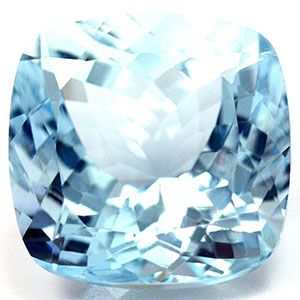
Aquamarine is the blue to greenish blue variety of beryl, the same mineral as emerald, and its color is usually light. GIA describes the most valuable color as a dark blue to slightly greenish blue with moderately strong intensity: the purer and stronger the blue, the higher the price. Paleness is the usual weakness: a very light stone can look like clear glass once set, so judge the blue in the video at about the stone's real size, not zoomed in.
For most buyers the value lies a step below the deepest blues: a medium blue that reads plainly as blue at a glance, without the premium the rarest saturated stones carry. Trade names such as Santa Maria describe a deep blue, not a grade; paying for the word buys a label, not a different stone. Brazil, Nigeria, Madagascar, Mozambique and Pakistan are among its sources, and each stone's page shows the origin its supplier lists, which only a lab's origin report confirms.
Heated for a Purer Blue
Most aquamarine on the market has been heated, GIA notes, to take out a green or yellowish tint and leave a purer blue. The result is stable, and a heated stone needs no special care, so the blue it leaves is the blue the stone keeps.
A stone's treatment line repeats what its report says, and our guide to gem lab reports covers what else a report holds. Where the page shows no treatment reported, the report names none. Heating aquamarine usually leaves no trace a lab can detect, so that is no proof the stone was never heated, nor a reason to pay a premium. Rarely, a fracture is filled so it shows less; a report names the filling where the lab finds it, and a filled stone should only be cleaned with warm soapy water.
Eye-Clean Is the Starting Point
Most faceted aquamarines are eye-clean, and buyers expect a clean stone with good transparency; rough with visible inclusions usually goes to cabochons, beads or carvings instead. So a clean face is standard for aquamarine, not a premium to chase. Once nothing shows to the unaided eye, paying more for a stone cleaner still under magnification adds price, not anything you will see in a ring.
Spend your attention on transparency and cut instead. A hazy or milky stone loses more beauty than a tiny crystal ever takes away. Because the color is light, a shallow cut can leave a washed-out, see-through patch in the center of the face. In the video, look for brightness across the whole stone as it tilts, and skip any stone with a fracture breaking its surface.
Bigger Stones, Deeper Blue
Aquamarine grows in large crystals, so big stones are easy to find, and its color deepens as size goes up, which makes size a better use of a budget than extra clarity. Strong color under about 5 carats is the exception, found mainly in stones from some African mines, so a small deep-blue stone can cost more per carat than a larger one of the same color. Aquamarine is also less dense than sapphire, so it faces up larger than a sapphire of the same weight; compare stones by their millimeter measurements, and see why a carat measures weight rather than size.
Cutters favor emerald cuts and ovals, with cushions, pears and hearts too. The step facets of an emerald cut show the color calmly and evenly, while the brilliant facets of an oval or cushion add sparkle and can make a light blue look a little stronger. Aquamarine shows its stronger blue when the table runs parallel to the length of the crystal, the same orientation that keeps the most weight, so cutters usually face it that way.
Wearing Aquamarine Every Day
At 7.5 to 8 on the Mohs scale, aquamarine is durable enough for a ring worn daily if it is protected from hard knocks and scratches. Warm soapy water is always safe. GIA rates ultrasonic and steam cleaners as usually safe, but not for a stone with fractures or liquid inclusions, which you cannot judge by eye, so leave those machines to a jeweler. Keep it away from strong heat.
Prices From Our Catalog
| Carat Weight | Median Price per Carat | Stones Counted |
|---|---|---|
| 5.00 ct and up | $1,026 | 61 |
The median price per carat of the aquamarine on sale here in each band, in US dollars, as of November 2, 2026. The grid shows each stone’s own price in your currency.
Aquamarine Color and Price by Size
| Under 2 Carats | 2 to 5 Carats | Over 5 Carats | |
|---|---|---|---|
| Depth of blue to expect | Usually light, and often pale below a carat | Light to medium, sometimes stronger | Medium to deep blue tends to be easiest to find |
| What to look for in the video | Blue that still shows at the stone's real size | Even color with no watery center | Clean transparency and blue reaching the corners |
| Price per carat for a deep blue | Often the highest, since strong color is rare this small | High where the blue is strong | Can be lower than a small stone of the same blue |
Questions
How much is a real aquamarine worth?
It depends most on the depth and purity of the blue, then on size and cut. A pale stone of a few carats costs little; a deep, saturated blue of the same weight costs far more, and strong color is hardest to find in small stones. Put the grid in price order, with figures in your currency, then let the blue in each video decide before the numbers do.
Is aquamarine a cheap stone?
Not cheap, but kind to a budget for its size. Aquamarine forms in large crystals, so big, clean stones are far easier to find than in sapphire or emerald, and its price climbs mainly with the depth of blue rather than with weight alone. So a medium blue of several carats is within reach where a sapphire that size would not be. Blue topaz, often mistaken for it, usually costs far less.
How do you tell if you have a real aquamarine?
Only a lab can say for certain. Blue topaz, most of it colorless topaz that was irradiated and heated, is the usual stand-in, along with lab-grown spinel and glass. A gemologist separates them by how strongly each bends light and by density, tests a buyer cannot do at home. Every aquamarine on this page is natural, and the lab whose report confirms that is named beside the stone.
Is a greenish aquamarine a bad buy?
No. A slightly greenish blue sits within the range GIA calls most valuable, and a stone with a more obvious green tint usually costs less than a pure blue of the same depth. Many people like its softer, sea-glass look. The faults to avoid are grayness and paleness, not green. Choose by the stone you see in the video: a green tint you enjoy is a saving, not a flaw.
Is aquamarine durable enough for an engagement ring?
Yes, with some care. GIA calls aquamarine durable enough for everyday wear, but it is softer than sapphire or diamond, so over years its facet edges can wear and a hard knock can chip it. For an engagement ring, choose a setting that guards the corners, such as a bezel, or V-prongs on an emerald cut or pear. A pale stone loses its sparkle quickly under a film of lotion or soap, so clean it often.