Oval Diamond Ratio, Bow-Tie and Pears: How to Choose
The ratio sets the shape. The bow-tie and symmetry matter, but the overall appearance comes first. Here's how to judge ovals and pears by eye, and where you can save.
Written by Love & Carat, with AI assistance, from the sources listed below. How we write
In This Guide (9)
- Why ovals and pears look bigger for their weight
- Which oval diamond ratio should you choose?
- How to judge the oval diamond bow-tie from a video
- How to judge a pear shaped diamond
- Settings that protect a pear's point
- Oval vs pear engagement ring: where to spend and what to skip
- What to ask before you buy
- Questions
- Sources
An oval diamond ratio is the stone's length divided by its width. It decides whether the oval looks soft and rounded or long and slim: GIA's oval guide describes 1.30 to 1.40 as gently rounded and 1.40 to 1.50 as the classic, most popular oval. Once you've picked a ratio, judge the bow-tie and the symmetry by eye on video, because GIA gives neither ovals nor pears a cut grade.
Why ovals and pears look bigger for their weight
Carat is a measure of weight, not size. GIA says an oval has a larger face-up area than a round diamond of the same carat weight. An oval has a larger surface area than a round diamond of the same carat weight, so it looks bigger, and GIA notes it can make fingers appear longer and more slender. A pear's tapered outline can also give a ring an elongated look.
That is the first saving in this category. The shape already gives you visual size, so you rarely need to stretch on weight.
Ovals also have a practical advantage. With no sharp corners, they are less prone to chipping than shapes like princess or marquise. A pear has one point, and that point needs protecting. We cover settings below.
Which oval diamond ratio should you choose?
To find the ratio, divide the length by the width. A stone 1.4 times as long as it is wide has a ratio of 1.40:1. GIA describes the bands like this:
| Ratio | How it looks |
|---|---|
| 1.20:1 to 1.29:1 | Shorter and rounder; can resemble a rounded cushion or a slightly off-round stone |
| 1.30:1 to 1.40:1 | Gently elongated; flatters most fingers and suits many settings |
| 1.41:1 to 1.50:1 | Longer; chosen for a slimming effect or a more dramatic look |
| Above 1.50:1 | Long and narrow; rarely seen, and may show a stronger bow-tie |
These bands come from GIA's oval buying guide, which adds that many people prefer 1.30:1 to 1.50:1 because it is "not too long and narrow, and not too short and wide." An earlier GIA buying guide published December 12, 2013 gave a wider optimal range of 1.33 to 1.66:1. It also said that personal preference will likely decide.
That's the honest summary: no single ratio is correct. Our advice is to pick a band, not a number. A 1.38 and a 1.42 may look similar on a hand; compare their outlines rather than relying on the numbers. Don't turn down a lovely stone because it sits a hair outside your target, and don't pay more for a ratio that only looks better on paper.
How to judge the oval diamond bow-tie from a video
The bow-tie is a dark pattern that can run across the middle of an oval or pear. GIA explains that it appears when light is blocked by your own head and shoulders as you look at the stone, and that the closer your face is to the diamond, the stronger it looks. A well-cut stone keeps it small. GIA says some degree of bow-tie is always present in ovals and can add character when subtle and balanced; many pears show a bow-tie too.
What you want to avoid is a heavy one. A bow-tie can vary from light gray to black, and the darker or larger it is, the more it detracts. For pears, GIA says the bow-tie gets darker as the difference between length and width grows and pavilion angle variations become more extreme. Because bow-tie visibility can vary even within the same ratio range, the ratio alone won't tell you how a stone looks. A video from several angles in ordinary light can help.
When you watch one, look for these things:
- Movement. As the stone rocks, check whether the dark area looks subtle rather than distracting. A solid black band that stays put at every angle is the one to pass on.
- Size. A subtle gray bow-tie may be less distracting than a large, dark one. A larger or darker bow-tie can detract from the stone's face-up appearance.
- Lighting. GIA suggests viewing fancy shapes in daylight and in the light where the ring will be worn. Ordinary light is a fairer test than a bright studio.
- Like with like. Compare stones of similar ratio and weight, side by side.
How to judge a pear shaped diamond
A pear rewards close attention to its outline. GIA's advice is to draw an imaginary line down the length of the stone and check that the two halves mirror each other: shoulders, belly, wings and facets alike. The wings should form attractive arches. Wings that are too flat make the stone look narrow, and wings that are too rounded make it look short and stubby. The rounded end should look like a semi-circle.
Then check the details that throw the balance off. The table should sit centered on the line of symmetry. The culet, and the keel line where there is one, should be the same distance from both sides. Look for inclusions near the point, because GIA calls it the area most sensitive to damage. Watch for color gathering there too.
For ratio, GIA notes that many experts prefer about 1.50 to 1.75:1, and its 2013 guide gives the same preferred range. IGI's fancy-shape cut guidelines list 1.40:1 to 1.75:1 for an Excellent pear brilliant. Those guidelines also call for a bow-tie effect that "is not significant," with the final grade subject to visual confirmation. Either way, the eye has the final word:
When deciding between different pear shaped diamonds, the overall appearance is more important than the specific proportion details.
Ovals are checked the same way, with two lines instead of one. Draw one line down the length and one across the middle. Both pairs of halves should mirror each other, and the culet should be dead center. Look for even, well-rounded shoulders.
Settings that protect a pear's point
The point of a pear is the part most likely to chip, so the setting should cover it. GIA shows two good answers: a V-prong at the point, or a bezel that wraps the whole edge. Its 2013 guide says that if you choose prongs, the setting should include a V-shaped prong at the point.
Traditionally, a pear is worn point away from you, which many in the trade say makes the finger look more slender. Point toward you, or set sideways, is also an option and gives a more contemporary look.
An oval has no point, so four prongs or six is a matter of taste. Four show slightly more of the outline. Six give extra points of hold. We'd look at both on the stone you've chosen.
Oval vs pear engagement ring: where to spend and what to skip
Choosing between the two is mostly about mood. An oval is soft and symmetrical, and it pairs well with other shapes in multi-stone rings. A pear is more directional and a little more unusual. Both carry their weight well. You can compare them on our oval and pear shaped diamonds page.
Choose the ratio band you like, then buy the stone whose bow-tie and symmetry look best on video, not the one with the most impressive paper.
Here is where we would put the money, and where we wouldn't:
- Spend on appearance. Outline, a soft bow-tie and a clean, balanced shape matter more than anything else. On symmetry, GIA treats "Excellent" or "Very Good" as signs of cut quality. If a Very Good stone looks as balanced as an Excellent one on video, we wouldn't pay a premium for the higher grade.
- Clarity: eye-clean is enough. Buy a stone that's eye-clean. With a pear, take extra care near the point, and remember that a larger table can make inclusions easier to see.
- Color: match it to the metal. GIA notes that ovals can show more color at their tips and suggests G–H for a bright, white look; check a pear's point for color concentration too. It also says a J can look beautiful in yellow or rose gold, which complements the warmth. Our guide to stones for setting in gold goes further.
In budget terms:
- A tighter budget. Choose a lab-grown oval or pear a little under your dream weight, since the shape adds visual size. Pick a warmer color in yellow or rose gold and eye-clean clarity.
- A middle budget. Consider a G–H lab-grown stone with Very Good or Excellent symmetry, compare its color against your chosen metal, and put the rest into size.
- A generous budget. Choose a larger lab-grown stone in D–F set in white gold or platinum, or a natural stone if that matters to you. Our honest comparison of lab-grown and natural covers that choice. Lab-grown diamonds usually cost less than comparable natural ones, which is why we suggest them wherever they look the same.
Stones That Fit This Guide
View all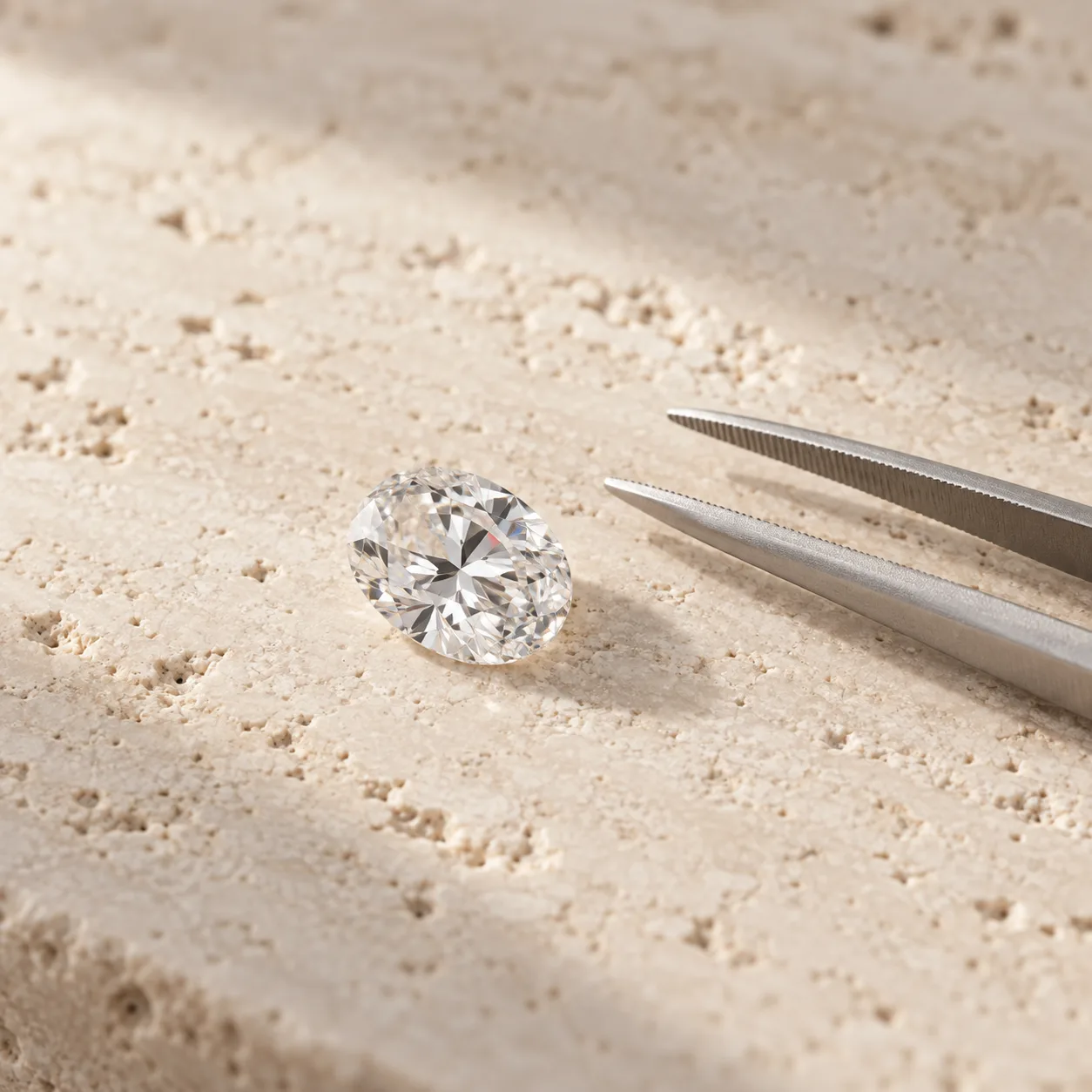
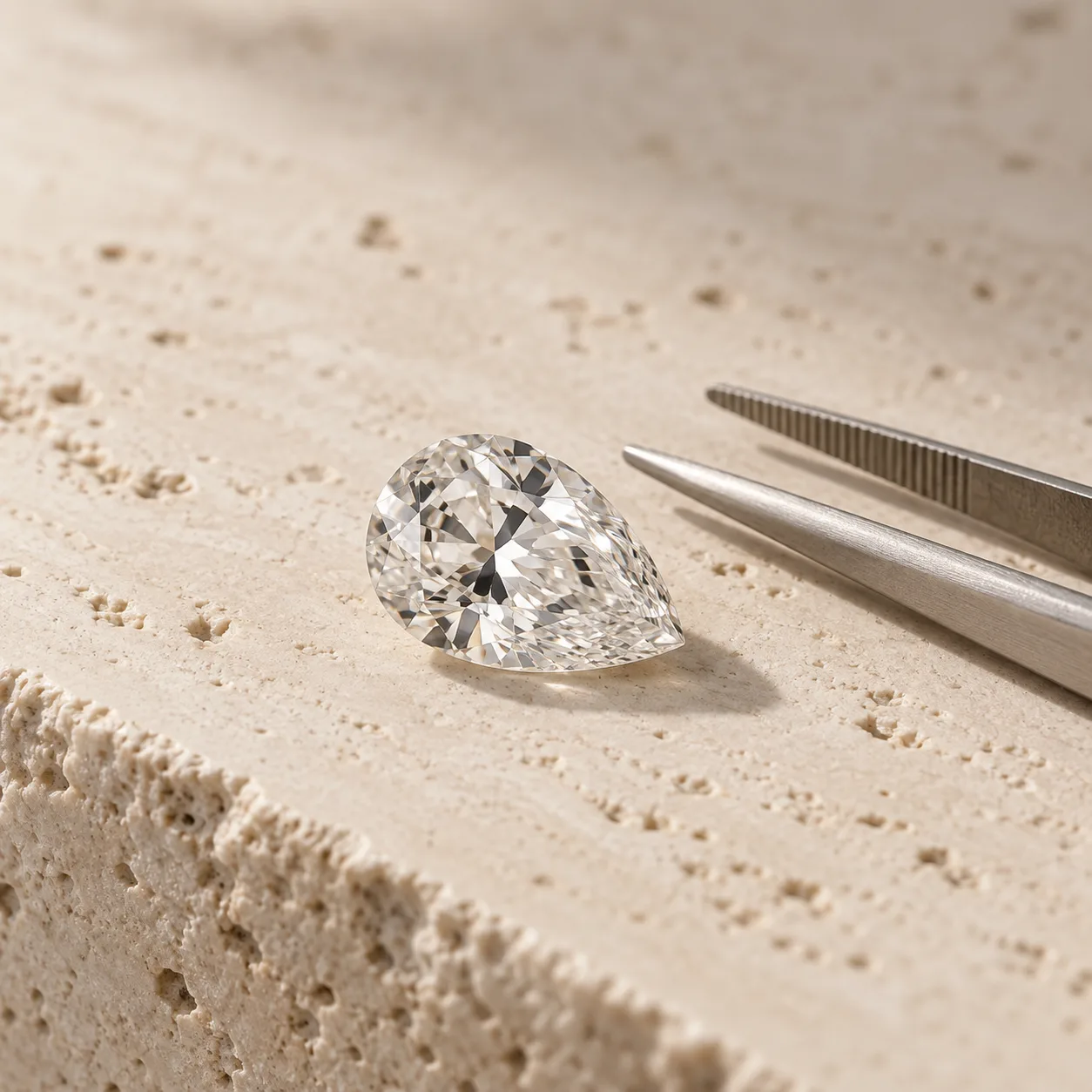
Every diamond we sell comes with a GIA or IGI grading report. For fancy shapes, GIA doesn't issue a cut grade: its cut grading system, launched in January 2006, covers standard round brilliants. Instead, it reports polish and symmetry. GIA's symmetry terminology includes features such as table off-center, culet off-center and uneven outline, which are exactly the faults that show on a pear.
What to ask before you buy
- What is the length-to-width ratio, and does it sit in the band I like?
- Can I see a video of the stone rocking in ordinary light?
- What polish and symmetry grades does the report give, and does the stone's outline look balanced on video?
- For a pear: are there inclusions near the point, and does color gather there?
- What exactly protects the point: a V-prong or a bezel?
- If the stone isn't what I expected, what happens? Our returns policy sets out how returns work.
Ask these questions, trust what you see on the video, and you'll end up with an oval or pear that looks wonderful, without paying for grades your eye can't see.
Questions
What does a 1.45 ratio oval diamond look like?
It looks like a classic oval. It sits in the 1.40 to 1.50 range that GIA calls the most popular, and in the longer band chosen for a slimming effect on the finger. Two stones at 1.45 can still look different, so judge each one on video.
Should an oval diamond have 4 or 6 prongs?
Both are sound choices, and it comes down to taste. Four prongs show a little more of the outline. Six give extra points of hold, which some people prefer for a ring they wear every day.
Is a 1.5 ct oval too big?
Not in itself. Ovals spread their weight over a larger face-up area than rounds, so a 1.5 carat oval looks generous. Whether it suits you depends on your hand and your taste, and a lab-grown stone keeps the cost of that size down.
Do oval and pear diamonds get a cut grade?
GIA gives a cut grade only to standard round brilliants. For fancy shapes like ovals and pears it reports polish and symmetry instead. IGI publishes its own fancy-shape cut guidelines, with the final grade subject to visual confirmation.
Sources
- Oval Cut Diamond Buying Guide | Key Factors & Things to Consider | GIA 4Cs
- Estimating Cut Grade booklet rev12-09
- Pear Shaped Diamond: Tips for Picking the Perfect One
- Expert Tips for Buying Fancy Shaped Diamonds | GIA's Holiday Guide | GIA 4Cs
- Diamond Polish and Symmetry: Guide to GIA Terminology and Abbreviations
- IGI - FANCY CUT GRADING
Nothing on this page is an appraisal or financial advice. Markdown version · RSS