
Certified Lab-Grown Diamonds: How to Read a GIA or IGI Report
Read a lab-grown diamond report from the top: what the stone is, whether it was treated, how it grades, and how to confirm the paper matches the stone.
Written by Love & Carat, with AI assistance, from the sources listed below. How we write
In This Guide (9)
- What a grading report is, and what it isn't
- The identification line: grown, how, and whether it was treated
- The 4Cs: how each report describes quality
- Measurements, proportions and cut
- The laser inscription and checking a report online
- GIA or IGI: when the difference matters
- What a report doesn't tell you
- Questions
- Sources
A grading report for a lab-grown diamond tells you three things. It confirms the stone was grown rather than mined. Depending on the laboratory and report type, it may also give the growth method or information about post-growth treatment. And it describes its quality. Read it from the top down, compare any girdle inscription with the document, and ask the issuing laboratory how to verify that type of report or assessment.
GIA and IGI both provide documentation for lab-grown diamonds, but since October 1, 2025, GIA has used an overall quality assessment for eligible D-to-Z stones rather than the individual grading terms used for natural diamonds.
What a grading report is, and what it isn't
A grading report is a laboratory's description of one stone, as it was when the laboratory examined it. It identifies the material, records its characteristics and, for a grown stone, says so in plain words. Our certificate glossary entry covers the basics.
A report is not an appraisal. It carries no price and no valuation. It says nothing about resale, because diamonds are not investments, grown or mined.
Every diamond we sell comes with a GIA or IGI grading report. The rest of this guide walks through what you'll find on one, line by line.
The identification line: grown, how, and whether it was treated
The first thing to find is the line that tells you what the stone is. GIA changed its wording effective July 1, 2019. GIA said its 2019 report for lab-grown diamonds used “laboratory-grown” in the identification line and did not use “synthetic”. That 2019 report format also carries a standard statement:
This is a man-made diamond produced by CVD (Chemical Vapor Deposition) or HPHT (High Pressure High Temperature) growth processes and may include post-growth treatments to change the color.
Under the same 2019 format, all detected clarity treatments would be disclosed. For colored lab-grown diamonds, GIA's current reports include an assessment of growth-type and post-growth treatment, according to its fee schedule for Q3 2026.
IGI announced new treatment wording in January 2021. In its January 2021 announcement, IGI described wording for untreated CVD and HPHT stones - "as grown with no indication of post-growth treatment" - and said other CVD reports may say "may include post-growth treatment"; IGI now says growth-process and treatment details are noted upon request. IGI says that upon request, the growth process and the presence of treatments are noted in the comments section of its lab-grown report. IGI also lets customers request specific diamond types: type IIa for CVD and type II for HPHT. If CVD and HPHT are new terms, our guide to the types of lab-grown diamonds explains them.
So what is a post-growth treatment? IGI explains that treatments are commonly used to reduce, eliminate or change a lab-grown diamond's color appearance; for stones in the D-to-Z color range, examples include HPHT and low-pressure high-temperature treatment. In IGI's view, those treatments alter the stone at the molecular level and are considered permanent.
The 4Cs: how each report describes quality
This is where the two laboratories now part ways most clearly.
GIA since October 1, 2025
From October 1, 2025, GIA replaced its D-to-Z lab-grown services with a quality assessment. Its official name is the "Laboratory-Grown Diamond Quality Assessment." The assessment classifies qualifying stones as “Premium” or “Standard” based on clarity, color and cut. It no longer uses the grading terms GIA created for natural diamonds. GIA's president gave the reasoning:
Using descriptive terms for the quality of laboratory-grown diamonds is appropriate as most fall into a very narrow range of color and clarity.
As GIA announced them, the minimum criteria are:
| Premium | Standard (minimum) | |
|---|---|---|
| Clarity | VVS and higher | VS |
| Color | D | D–J; E–J meets the Standard color criterion, but D can also be Standard if another Premium criterion is missed |
| Polish and symmetry | Excellent | Very Good (symmetry Good for fancy shapes) |
| Cut grade (rounds only) | Excellent | Very Good |
A stone that misses any of the Standard minimums will not receive a GIA assessment at all. According to GIA's fee schedule for Q3 2026, the service covers colorless to near-colorless lab-grown diamonds of 0.15 carats or more. GIA's official page has the current terms.
Older GIA reports
GIA offered its earlier D-to-Z lab-grown services until September 30, 2025, so many stones still carry the older report. That format, introduced July 1, 2019, used words rather than letters for color: Colorless, Near Colorless, Faint, Very Light and Light. It prints the letter scale alongside for reference, so Near Colorless covers G, H, I and J. Clarity works the same way. For example, Very Slightly Included takes in what natural reports split into VS1 and VS2.
Colored lab-grown diamonds at GIA
GIA's colored lab-grown reports use the same scale as its colored reports for natural diamonds, but do not correlate to nature's continuum of rarity.
What we'd buy
Premium requires D color. Standard can include D-color stones that miss another Premium criterion, as well as stones with E-through-J color that meet its other minimums. Color differences within that range may be hard to see in a setting, so compare how the stones look to you. Our guide to which color grades look white shows where the eye stops noticing. For most people, a well-cut Standard stone is the better use of money.
Stones That Fit This Guide
View all
Measurements, proportions and cut
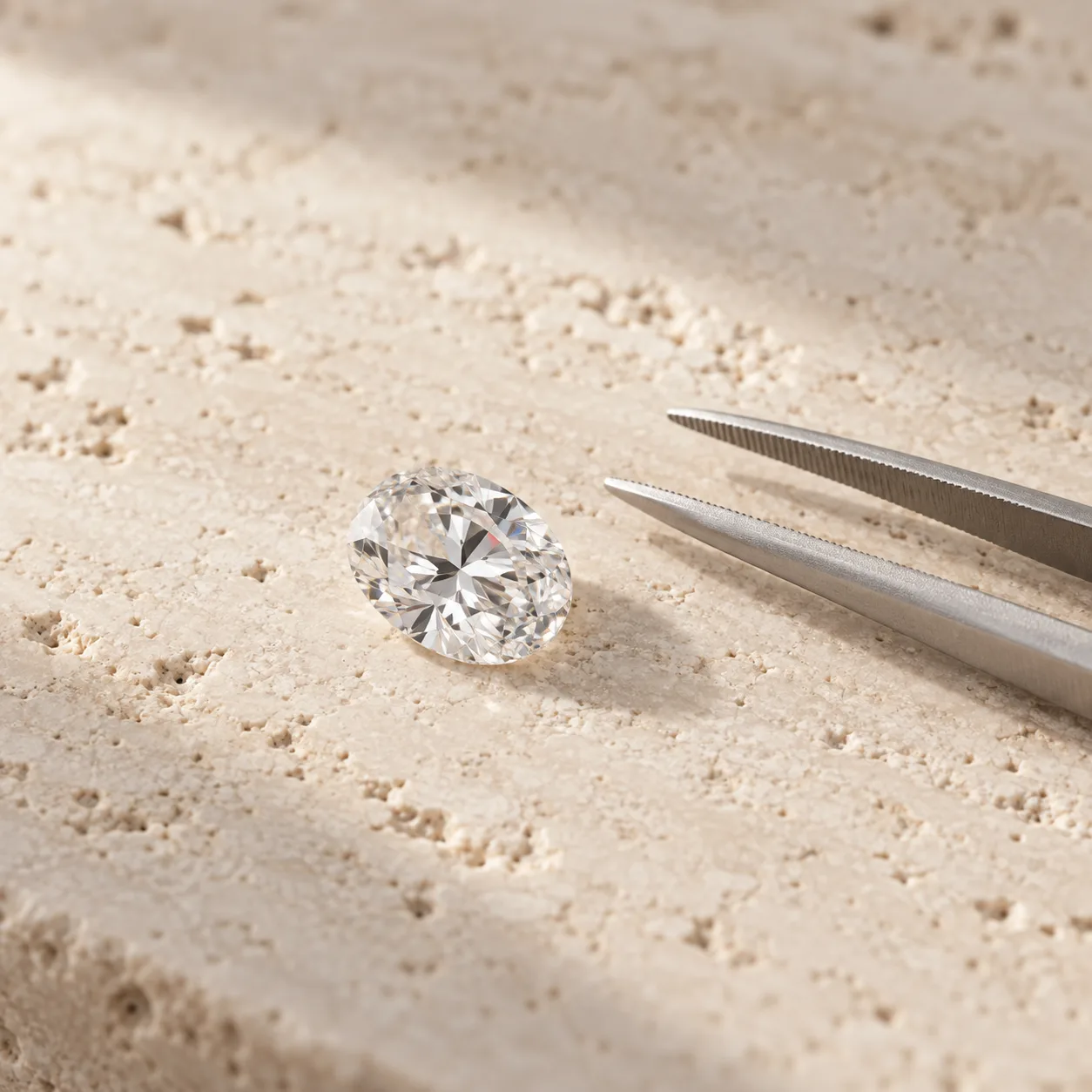
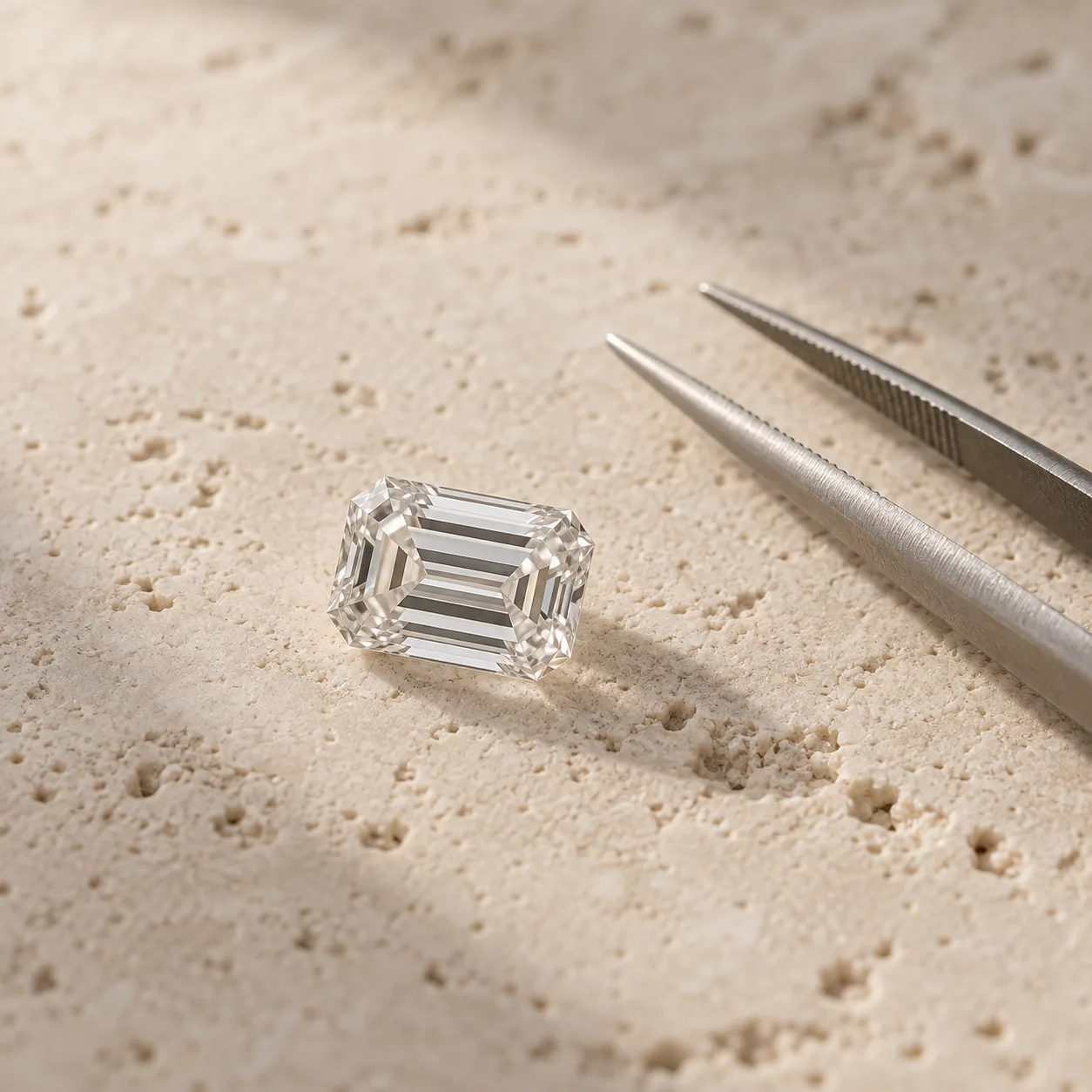
Under GIA's criteria, a cut grade applies to round brilliant cut diamonds only. For an oval, pear or emerald cut, GIA's cut-grade criterion does not apply; inspect the shape's outline and proportions yourself, as well as any details the document provides.
Two tools can help you understand cut on a round:
- FacetWare. GIA offers this free online cut estimator. You enter proportion and finish information, and it estimates a cut grade.
- AGS Ideal® Report. GIA also lists this supplemental report that assesses light performance, proportions and finish as an add-on, with limitations.
Where a report prints the stone's measurements and proportions, read them with our table and depth glossary entry open. Length and width help you judge how large a stone faces up; carat weight alone won't tell you that. If you're weighing where to spend, we'd put the money into the cut. Our guide to diamond cut grades explains why.
The laser inscription and checking a report online
GIA laser-inscribes the girdle of each assessed lab-grown diamond with the term “Laboratory-Grown” and the GIA quality assessment number. According to GIA's Q3 2026 fee schedule, the inscription of “Laboratory-Grown” plus the applicable report number is included with its lab-grown diamond report services at no extra charge.
For a GIA lab-grown report in the 2019 format, use GIA's Report Check to compare its database record with the document; its QR code also links there. For a current GIA Quality Assessment, ask GIA how to verify the assessment. If you have several reports, GIA's Report Check Plus lets you download results for multiple reports at once.
For an IGI report, check IGI's official site for its current verification instructions or ask IGI directly how to confirm the document. Use the laboratory's own site, not a link someone sends you.
GIA or IGI: when the difference matters
Each laboratory has its own way of describing itself. GIA calls itself the world's foremost authority in gemology. IGI says its gemologists grade according to the strictest international system. These sources do not establish that one laboratory grades more strictly than the other; compare the actual documents and how the stones look. Neither reputation replaces looking at the stone.
The choice of laboratory does matter in a few cases:
- You want the detail. GIA's current assessment gives you a classification rather than a single headline grade for each C. Some buyers prefer more granular grades for comparing stones.
- You care about treatment wording. IGI's reports can state "as grown" explicitly for untreated CVD and HPHT stones.
- You're buying a colored lab-grown diamond. GIA's colored reports assess growth type and post-growth treatment, so check what the report covers.
- You're comparing across laboratories. Compare like with like. A Standard from GIA and a letter grade from another report describe quality in different ways, so look at both stones rather than the paper alone.
When two verified stones look the same to you, the laboratory rarely matters to the eye. That's when we'd steer you to the cheaper one.
What a report doesn't tell you
- Price or value. A report doesn't say what a stone is worth. If you insure the ring, your insurer may ask for an independent appraisal. Our engagement ring insurance guide explains how that works in New York.
- How the stone looks in its setting. Grades don't show how a stone faces up in daylight, under a prong or next to your skin.
- What has happened since grading. A report records the stone as examined. GIA lists a follow-up service that can determine whether a lab-grown diamond has been damaged since its last polishing.
- Whether you'll love it. That part is yours.
Read the identification line, verify the number, then let your eye, not the highest grade, decide where the money goes.
Questions
What is the best certificate for lab-grown diamonds?
There is no single best report for every stone. GIA assesses eligible D-to-Z lab-grown diamonds using Premium or Standard, while IGI issues lab-grown diamond reports; check the document with the issuing laboratory and compare any girdle inscription with the stone. Every diamond we sell comes with one or the other.
What is better clarity, VS1 or VS2?
VS1 is one step higher than VS2. GIA's lab-grown report format introduced on July 1, 2019 put both under the single term "Very Slightly Included." If both stones look eye-clean to you, we'd usually take the cheaper VS2 and put any savings toward a cut you prefer.
Are lab-grown diamonds as good as natural diamonds?
They are diamonds, graded by the same laboratories, and the report clearly identifies them as grown. Lab-grown diamonds usually cost less than comparable natural ones. Where the two look the same to you, we'd recommend the lab-grown stone.
Is a certified lab-grown diamond a good investment?
No. Diamonds are not investments, and a grading report is not a valuation or a promise of resale value. Buy the stone because you like how it looks.
Does a grading report replace an appraisal for insurance?
No. A report grades the stone but does not put a price on it, and your insurer may ask for an independent appraisal. Ask your insurer what they need before you buy cover.
Sources
- Laboratory-Grown Diamond Services Details
- GIA Report for Laboratory-Grown Diamonds
- GIA Launches Updated Laboratory-Grown Diamond Services October 1
- Laboratory-Grown Diamond Services
- IGI: Post-Growth Treatment Added to Certification Process
- Are 'Post-Growth Treatments' Permanent? - IGI
- Lab Grown Diamond Report & Certification For Authenticity | IGI
Nothing on this page is an appraisal or financial advice. Markdown version · RSS