
Lab-Grown vs Natural Diamonds: An Honest Comparison
Same crystal structure, potentially indistinguishable by eye; GIA reports color and clarity for lab-grown diamonds. Here is what actually separates a lab-grown diamond from a natural one, and how to decide.
Written by Love & Carat, with AI assistance, from the sources listed below. How we write
In This Guide (9)
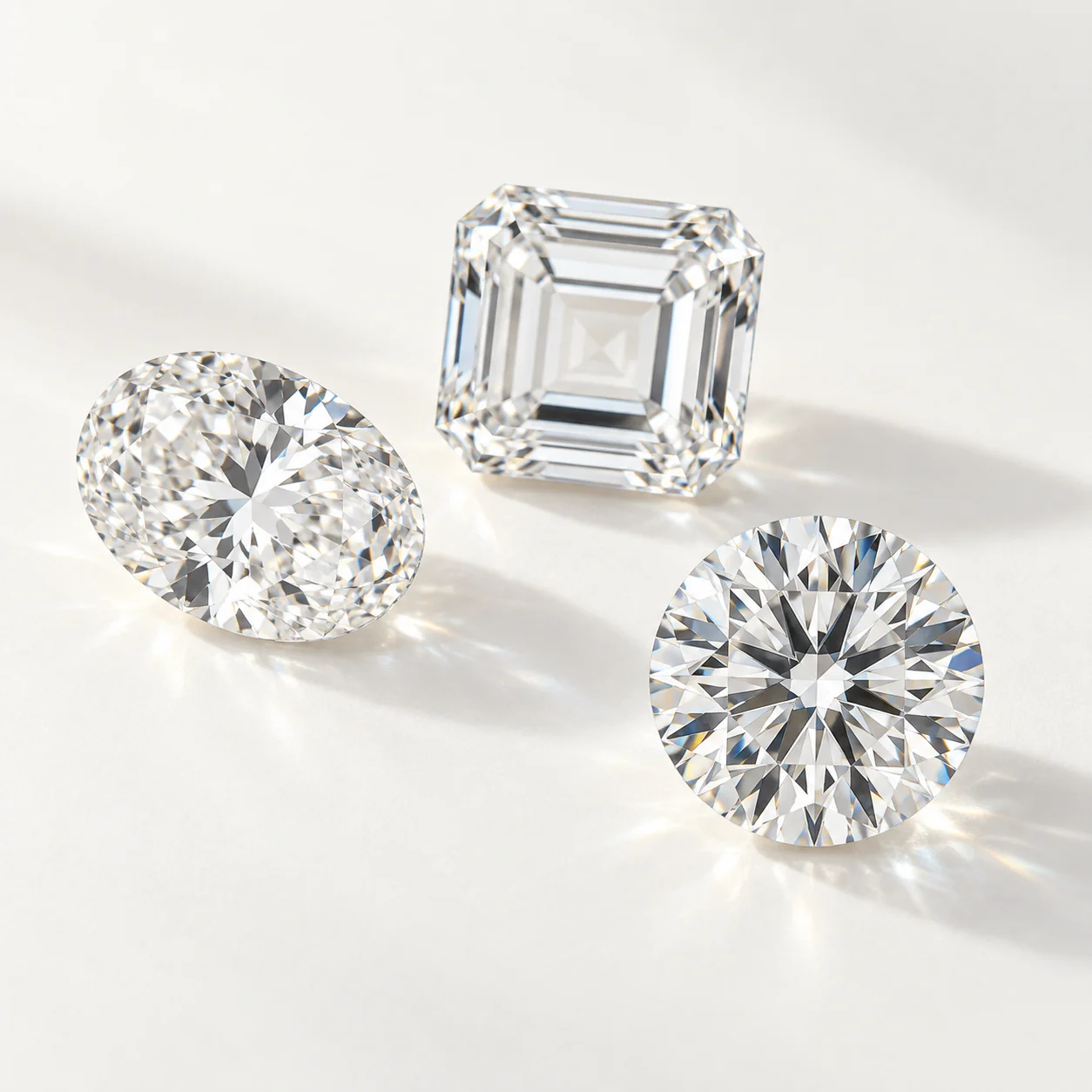
A lab-grown diamond and a natural diamond are the same material. They share essentially the same carbon crystal structure and can look indistinguishable by eye; GIA reports color and clarity for lab-grown diamonds. What differs is where and when the crystal formed, what the grading report says about it, and usually the price. For most people choosing a center stone, that makes a lab-grown diamond the sensible way to get the look without breaking the bank.
What is the same: the crystal and the grades
According to GIA, lab-grown diamonds have the same crystal structure as natural diamonds, made of tightly bonded carbon atoms. That gives them nearly the same chemical, optical and physical properties. They are not a look-alike, like cubic zirconia or moissanite. They are lab-grown diamonds, grown by people rather than by geology. Our glossary entry on lab-grown diamonds covers the basics.
By eye, the difference can potentially be indistinguishable.
The label on a stone tells you something too. The FTC's guidance says sellers should not use terms like "lab-grown" or "lab-created" unless the product has essentially the same optical, physical, and chemical properties as a mined diamond. That comes from its brochure on the Jewelry Guides, dated July 2019. So an honestly labeled lab-grown diamond is, by definition, not a simulant.
GIA assesses the color and clarity of lab-grown diamonds as it does for natural diamonds. GIA says its graders evaluate each lab-grown diamond with the same expertise and precision as natural diamonds. Its reports give detailed color and clarity specifications and a plot of the stone's clarity characteristics. Color and clarity grades describe the same kinds of characteristics in either origin; compare actual stones to see how they look. Most importantly, cut has a major effect on how much either stone sparkles.
Because it is the same material, a lab-grown diamond wears in a ring just as a natural diamond of the same cut and clarity does. There is no shorter lifespan to worry about.
What differs: origin, age and a few habits
The real difference is history. GIA notes that natural diamonds formed millions to billions of years ago, while lab-grown diamonds are young. They are made by one of two main methods: high-pressure, high-temperature (HPHT) growth, or chemical vapor deposition (CVD). We explain both in Types of Lab-Grown Diamonds: CVD vs HPHT.
GIA's data show some patterns in color, shape and post-growth treatment among diamonds submitted to its laboratory. GIA's summer 2024 update on lab-grown diamonds reports these patterns among the stones submitted to its laboratory:
- Color. The most common color grade among lab-grown submissions is E. Among natural diamonds, the largest share falls in the F–G range.
- Shape. According to GIA's summer 2024 update, 70% of D-to-Z natural diamonds are round, while shapes are more evenly distributed among the large lab-grown diamonds submitted to GIA. GIA suggests that cutters' efforts to retain weight from differently shaped grown crystals may help explain the pattern.
- Post-growth treatment. According to the same update, about 80% of CVD lab-grown diamonds submitted to GIA have had HPHT treatment after growth to improve their color grade.
That figure shows post-growth treatment is common among the CVD lab-grown diamonds submitted to GIA; it does not by itself tell you about any particular stone. The point is to check disclosure: GIA says its lab-grown report states whether there is evidence of post-growth treatment.
How the grading reports describe each one
GIA tests every diamond it examines to determine whether it is natural or lab-grown. For a lab-grown diamond it examines, GIA issues a separate lab-grown report, distinct from its natural-diamond grading report. GIA also laser-inscribes the girdle with the report number and a statement identifying the stone as lab-grown. GIA says it can determine whether a lab-grown diamond was grown by HPHT or CVD; check the individual report for any growth-method information. It also says whether there is evidence of any post-growth treatment.
Sellers have rules about wording as well. The FTC's July 2019 brochure says sellers should identify a lab-grown diamond as such immediately before the word “diamond” and just as prominently.
In April 2019, the FTC sent warning letters to eight companies. Among the concerns it raised:
- mixed descriptors in the same ad
- disclosures tucked away on FAQ or "education" pages
The FTC's April 2019 post says the Guides were updated in July 2018. For the current text, check the FTC's own pages.
Every diamond we sell comes with a GIA or IGI grading report. Our certificate guide walks through how to read one.
Can a jeweler tell them apart?
Not by looking. GIA is direct about it:
Because laboratory-grown diamonds are essentially chemically and optically the same as natural diamonds, traditional gemological observations and instrumentation are not able to tell them apart.
Tiny atomic-level irregularities in the crystal, called defects, do reveal whether a diamond is natural or lab-grown. Specialist equipment can read them. According to GIA, its desktop instrument, the iD100, helps jewelers distinguish natural diamonds from lab-grown ones and simulants in under two seconds. To confirm its origin, GIA advises sending the stone to a gemological laboratory for advanced testing. For a GIA-reported lab-grown diamond, verify the report and check that its identifying details match the girdle inscription; GIA uses advanced testing to establish origin.
Why does the distinction matter to the diamond trade? GIA notes signs that lab-grown diamonds have begun to complement and, in some cases, replace sectors of the natural diamond market, especially as their prices have fallen. Both kinds of stone are honest choices when they are properly disclosed.
Price, resale and the investment question
Lab-grown diamonds usually cost less than comparable natural ones. GIA describes the demand for them as driven partly by high-quality options at a reduced price point. That price gap is our whole reason for recommending them wherever they look the same.
Here is the plain part: diamonds are not investments. That goes for both kinds. We don't value stones, and we never promise resale value. GIA's 2024 update notes that lab-grown prices have fallen in recent years. So buy a diamond because you love how it looks and what it marks, not as a place to store money. If you insure the ring, your insurer may ask for an independent appraisal.
Buying online also means knowing the terms up front. Our returns policy sets out how returns work.
Environmental and ethical claims
This is where you should be most skeptical, from anyone. GIA notes that many manufacturers have promoted lab-grown diamonds as an environmentally friendly commodity.
Among the concerns in its April 2019 letters, the FTC flagged sellers who called their products "eco-friendly," "eco-conscious," "sustainable," etc. It reminded them that marketers must have a reasonable basis for any environmental claim. Under the Green Guides, sellers should also steer clear of general environmental benefit claims. The Green Guides were first issued in 1992 and last revised in 2012, according to the FTC.
So we won't tell you that one kind of diamond is simply "green" and the other is not. If a seller makes an environmental or ethical claim, ask what specifically it covers and how they back it up. Check whether a diamond is lab-grown or natural; every diamond we sell comes with a GIA or IGI grading report.
How to decide which suits you
Natural vs lab-grown diamonds is less a question of quality than of what you value.
A natural diamond may suit you if:
- a stone formed deep in the earth over millions of years means something to you;
- you are happy to pay more for that origin, even if you cannot see an origin difference in the stones you compare.
A lab-grown diamond may suit you if:
- you want the most beauty for your budget;
- you would rather put the savings toward a better cut, a larger stone or the setting.
Whichever you choose, spend where the eye can see it. We'd put the money into the cut first. Then drop color and clarity to the point where the stone still looks clean and white in a ring. The top grades mostly show up on paper.
When you are ready to compare, browse our center stones for engagement rings.
Same crystal, same grades, different origin and price: choose on what you value, and let the cut, not the certificate's top grades, take your money.
Questions
What is the lifespan of a lab-grown diamond?
A lab-grown diamond has essentially the same physical properties as a natural diamond, so it should last just as well. The setting needs care too; have the prongs checked from time to time.
Do wealthy buyers choose lab-grown diamonds?
Who buys lab-grown diamonds matters less than what suits you. The choice is whether the stone's appearance, origin and price fit what you want.
Can a jeweler tell if a diamond is lab-grown or natural?
Not with a loupe or traditional tools, according to GIA. Jewelers can use screening instruments such as GIA's iD100, and a gemological laboratory can confirm the origin with advanced testing.
Is a lab-grown diamond a simulant like cubic zirconia or moissanite?
No. A simulant resembles a diamond, while a lab-grown diamond has essentially the same crystal structure and properties as a natural diamond. In its July 2019 brochure, the FTC says terms like "lab-grown" should only be used for a product with essentially the same optical, physical and chemical properties as a mined diamond.
Sources
- How do I identify laboratory-grown diamonds?
- Laboratory-Grown Diamonds: An Update on Identification and Products Evaluated at GIA
- Simulants, Moissanite and Lab-Grown Diamonds | GIA 4Cs
- More Info About Laboratory-Grown Diamonds | Gemological Institute of America - 4Cs
- In the Loupe: Advertising Diamond, Gemstones and Pearls | Federal Trade Commission
- Green Guides | Federal Trade Commission
- Warning letters re-”mined” diamond sellers to describe products accurately | Federal Trade Commission
Nothing on this page is an appraisal or financial advice. Markdown version · RSS