New York Diamond Market: How the 47th Street Diamond District Works
One block of West 47th Street carries much of America's diamond trade. Here is how it got there, how its dealers work, and what that means when you buy.
Written by Love & Carat, with AI assistance, from the sources listed below. How we write
In This Guide (8)
The Diamond District concentrates much of New York's diamond trade on a single block. Dealers, wholesalers and retailers work on West 47th Street between Fifth and Sixth Avenues; the Diamond Dealers Club provides a bourse for its members, with bylaws covering ethical dealing and arbitration. For a buyer, that means a lot of choice in one place, and the need to compare stones by their grading reports rather than by the storefront.
How did the diamond trade end up on West 47th Street?
The trade didn't start in Midtown. According to the district's own history, New York's Diamond District began in about 1790 on Maiden Lane, near Wall Street, where jewelers gathered each day to sell to wealthy New Yorkers. A purpose-built ten-story tower at 14 Maiden Lane, completed in 1900, had reinforced floors for heavy vaults and large windows for the daylight dealers liked. Soon more than 300 jewelry firms were packed into a two-block stretch.
Rising rents pushed the trade out. In the early 1920s financial firms moved into lower Manhattan, and jewelers moved on to Canal Street and the Bowery. After the 1929 crash, falling rents let diamond firms detour to Fulton and Nassau Streets. As early as 1923, real estate broker Fenimore Goode had begun putting up buildings designed for the diamond trade on West 47th Street between Fifth and Sixth Avenues.
The move uptown then sped up. The same history describes how tens of thousands of European Jewish refugees fleeing Nazi persecution arrived in New York, among them skilled diamond merchants and artisans who opened businesses on 47th Street. JCK's reporting adds that most books trace the district's origins to the 1920s, when big retailers moved to Midtown and the trade followed them from Maiden Lane.
The block's official identity came later. JCK reports that then-Mayor Ed Koch named 47th Street "Diamond and Jewelry Way" in 1982. According to the city's December 11, 1997, release, Mayor Rudolph Giuliani opened the one-block 47th Street Business Improvement District, then the city's 41st and smallest, with over 2,600 independent businesses.
Who's who on the block?
Three kinds of institution shape the 47th Street diamond district.
- The bourses. The Diamond Dealers Club is the street's trading floor for professionals. JCK's oral history recounts that its first meeting in 1931 drew only 12 people; the club's first premises were at 80 Nassau Street, then the center of the trade. A second bourse, founded in the 1940s mainly by Belgian and Dutch immigrants and later called the Diamond Trade and Precious Stone Association, was the first to move to Midtown. The DDC later moved to 47th Street; the other bourse closed in 1998.
- The trade associations. The Diamond Manufacturers and Importers Association of America is a trade association. JCK reported in 2023 that it keeps an office at 580 Fifth Avenue.
- The BID. The Diamond District Partnership is a not-for-profit Business Improvement District formed in 1997 by business and property owners. It provides security, sanitation, streetscape improvements and marketing for West 47th Street from Fifth to Sixth Avenues.
A grading laboratory had a presence on the block when JCK reported on it in 2023. JCK reported in 2023 that the International Gem Tower, christened in 2013, was home to the DDC and the GIA. We explain how that laboratory and IGI produce their reports in GIA New York and IGI: where grading reports come from.
How do dealers actually trade with each other?
The Diamond Dealers Club's history shows how trade relationships have been supported by club rules, including provisions for arbitration. When refugees who knew the European bourses joined the DDC, they helped align its rules with those bourses, including bylaws on ethical dealing and settling disputes through arbitration. Membership was never automatic. A former club vice president recalled: "You needed endorsements."
JCK's oral history mentions a memo but does not describe the terms of any particular transaction. A former club director, remembering the club floor in its heyday, put the contrast this way:
You didn’t mess around with a memo and credit and a million problems. You went to buy a diamond and you could buy it, bang! It was a real marketplace.
The club also began supporting virtual trading. JCK reported in 2023 that, during the pandemic, the DDC set up WhatsApp groups for vetted members and that some dealers who had downsized were using the club as their office.
The trade's freedom to deal is also a matter of record. In a 1955 consent decree under the Sherman Antitrust Act, the DDC and the Diamond Center were enjoined from agreeing to restrict diamond imports or exports or to hinder any dealer from "free and unlimited trade in diamonds" with any other.
What can you learn about a diamond's path to 47th Street?
New York used to cut a lot of its own stones. That is much less true now. One former club secretary told JCK that New York went from 6,000 cutters in 1944 to 1,000 once Antwerp rebuilt its cutting industry after the war. By the club's 75th anniversary, the same oral history noted, New York was "no longer a manufacturing hub." A study by the 47th Street BID, reported by JCK, listed an aging workforce and competition from abroad among the trade's challenges, and quoted the BID's director calling for "a new generation of cutters and polishers."
Those accounts show why you shouldn't assume a diamond sold on 47th Street was cut there. Ask a seller what they know about a particular stone's path to the counter rather than assuming it was cut or traded locally. The scale is large. In its undated history, the Diamond District Partnership estimates that 90% of diamonds in the United States pass through the district and lists more than 2,600 businesses, 33,000 employees and approximately $24 billion in annual sales; these are the partnership's figures, not verified current totals. Back in 1997, Mayor Giuliani put the share at at least three-quarters of all diamonds entering the country.
For most buyers, the chain matters less than its paperwork. Ask to see a diamond's grading report and, if it has a laser inscription, check that the inscription matches the report; use the report and the stone's appearance to compare your options. We cover what "wholesale" does and doesn't mean on the block in NYC wholesale diamonds.
What does this mean if you buy on 47th Street?
The block gives you real choice and real expertise within a short walk. You don't have to make a decision in a single afternoon. A few habits keep you in control.
- Choose your own doors. The BID's study noted that street "hawkers", whom many feel hurt the block's image, raise a complex legal issue because commercial speech has constitutional protection. You don't have to follow anyone inside. Pick the stores you want to see.
- Insist on the report. For a diamond you're considering, ask to see its GIA or IGI grading report; if the diamond has a laser inscription, check that it matches the report. Our glossary explains what a grading certificate tells you.
- Get everything in writing. That means the price, the stone's report details, and the refund or exchange terms. Ask each seller for its refund or exchange terms in writing. We explain how they work in New York refund policy law for jewelry.
- Check the tax separately. Check New York State's official guidance to find out how sales tax applies to your purchase. For more reading, see our guide to New York sales tax on jewelry; check New York State's official guidance for current rules and rates.
- Compare like with like. Compare quotes on certified stones with similar shape, carat weight, grades and appearance. Our guide to paying a fair price at a New York jeweler walks through how.
Is the Diamond District cheaper than Fifth Avenue, an independent jeweler or buying online? We don't know of any reliable figures that show it. Each way of buying has its strengths. What you can control is the comparison: same shape, same grades, same laboratory.
Which stone should you actually buy?
Wherever you shop, the same rule saves the most money. Pay for what the eye can see, not for what only a lab report can.
- Put the money into the cut. A well-cut stone can look brighter and may face up larger than a poorly cut one of the same weight.
- Stop at eye-clean. If two otherwise comparable diamonds look equally clean to your eye, you needn't pay extra for the flawless clarity grade.
- Drop a color grade or two. Especially in yellow or rose gold, a near-colorless stone often faces up just as white as a colorless one.
- Consider a lab-grown diamond. A lab-grown diamond is chemically and optically a diamond. It usually costs less than a comparable natural one, and where the two look the same, we'd recommend the lab-grown diamond.
The history of 47th Street is worth knowing, but a grading report helps you compare the diamond you're buying.
Stones That Fit This Guide
View all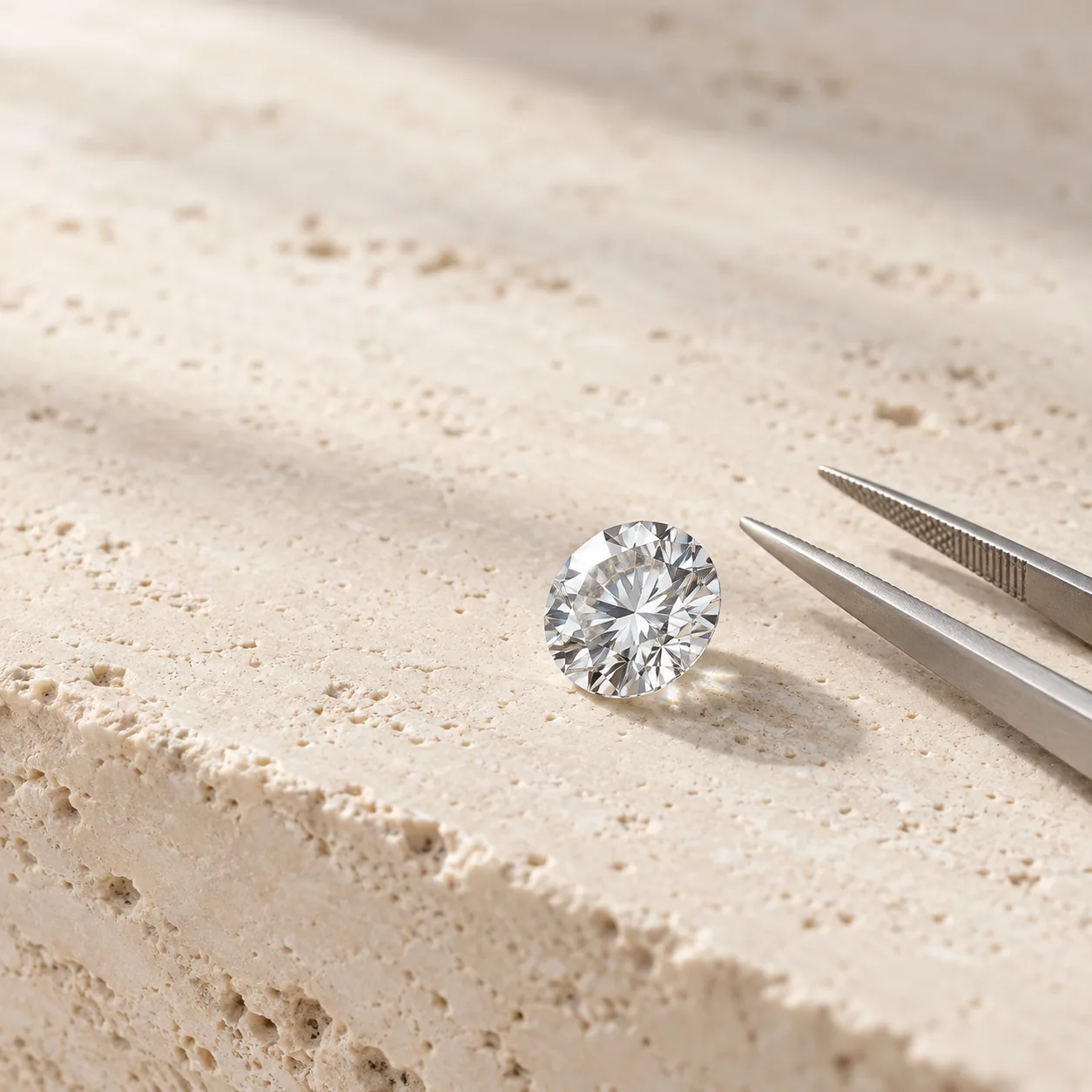
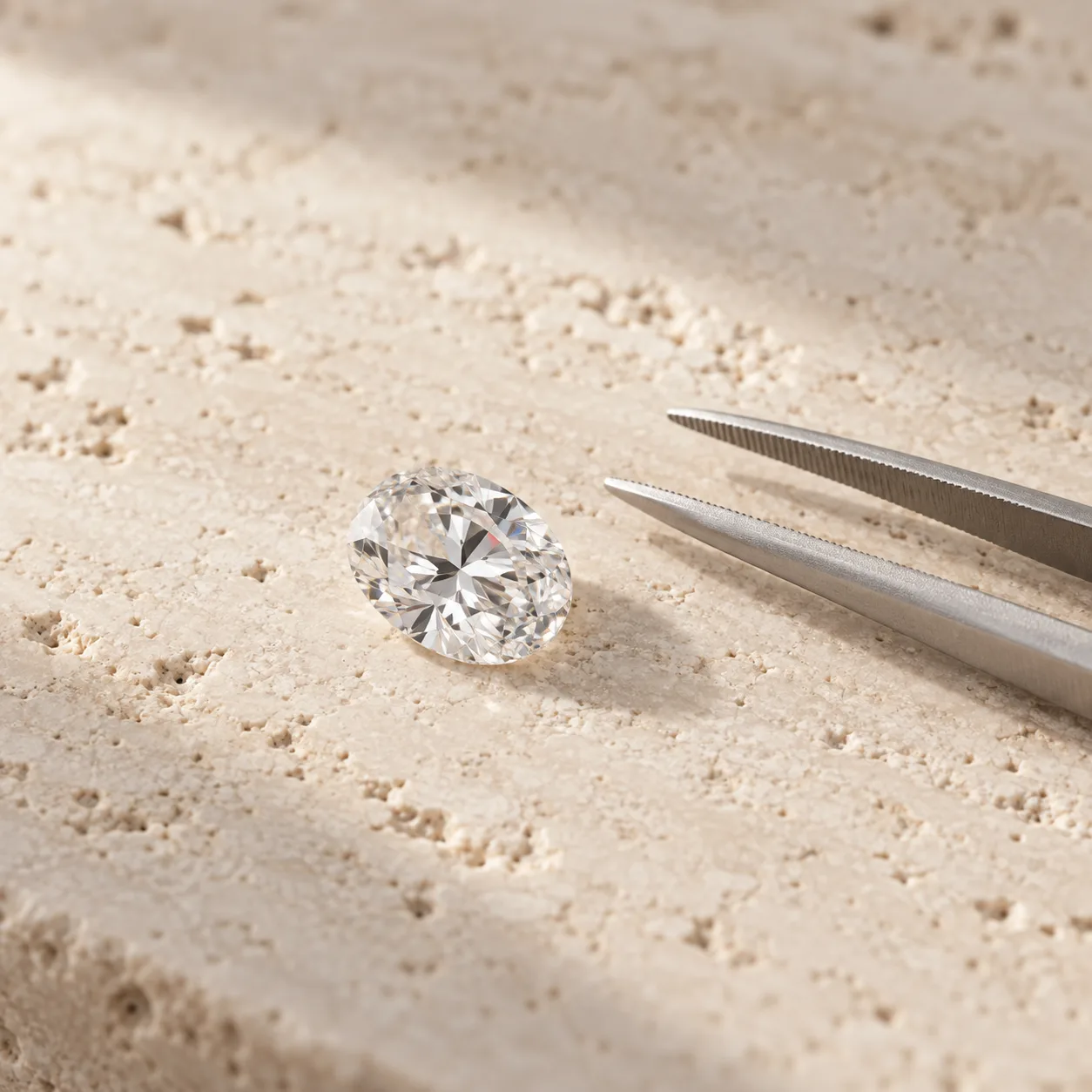
We're an online jeweler based in New York, with an office at 45 Rockefeller Plaza that doesn't take visitors, and every diamond we sell comes with a GIA or IGI grading report. Orders ship insured and signed for, and we pay the import duty on orders to the US. Whether you buy from us, from a dealer on the block or from another jeweler, the checklist above works the same way.
Questions
Is it worth going to the Diamond District in NYC?
It can be, if you arrive knowing the shape, size and grades you want and you're ready to compare certified stones side by side. Walk in and pick your own stores, get every price in writing, and don't feel you have to decide on the day.
Are diamonds cheaper in the NYC Diamond District?
We know of no reliable evidence that one way of buying is always cheaper than another. Collect a few quotes on certified stones with similar shape, carat weight, grades and appearance—from the block, independent jewelers and online—and compare those.
How much is a 1 carat diamond worth right now?
We don't value stones, and no single figure covers every one-carat diamond, because cut, color and clarity move the price a long way. Diamonds are not investments, so judge a price against comparable certified stones on sale today, not against what you might sell it for later.
What is the best cut for a diamond?
There's no single best cut for every shape; compare how the stones handle light, and protect cut quality where your chosen shape has a cut grade. A well-cut diamond can look brighter and may appear larger than a poorly cut one of the same weight. If your budget is fixed, cut is the grade we'd protect first.
Sources
- History | 47th Street BID | The Diamond District
- Press Release Archives #732-97 Mayor Giuliani Cuts 'Diamond' to Open 'Diamond District BID
- Life on the Street - JCK
- Study: Diamond District Faces Critical Moment - JCK
- DDC Celebrates Diamond Jubilee: An Oral History - JCK
- Final Judgment: U.S. v. Diamond Dealers Club, Inc., et al.
- About Us | 47th Street BID | The Diamond District
Nothing on this page is an appraisal or financial advice. Markdown version · RSS