Loose Diamonds NYC: How to Buy the Stone First and Set It Second
Choose the diamond on its grading report, check the inscription, then pick the setting. Here is how that works on 47th Street, with a jeweler, or online from New York.
Written by Love & Carat, with AI assistance, from the sources listed below. How we write
In This Guide (8)
The best way to buy loose diamonds in NYC is to choose the stone first, on its own grading report, and pick the setting around it afterwards. You can do that on 47th Street, with an independent jeweler anywhere in the city, or online from a New York jeweler. Wherever you buy, ask for a GIA or IGI report and a detailed written receipt; if the diamond is inscribed, match the inscription to the report.
Why buy the diamond loose and choose the setting second?
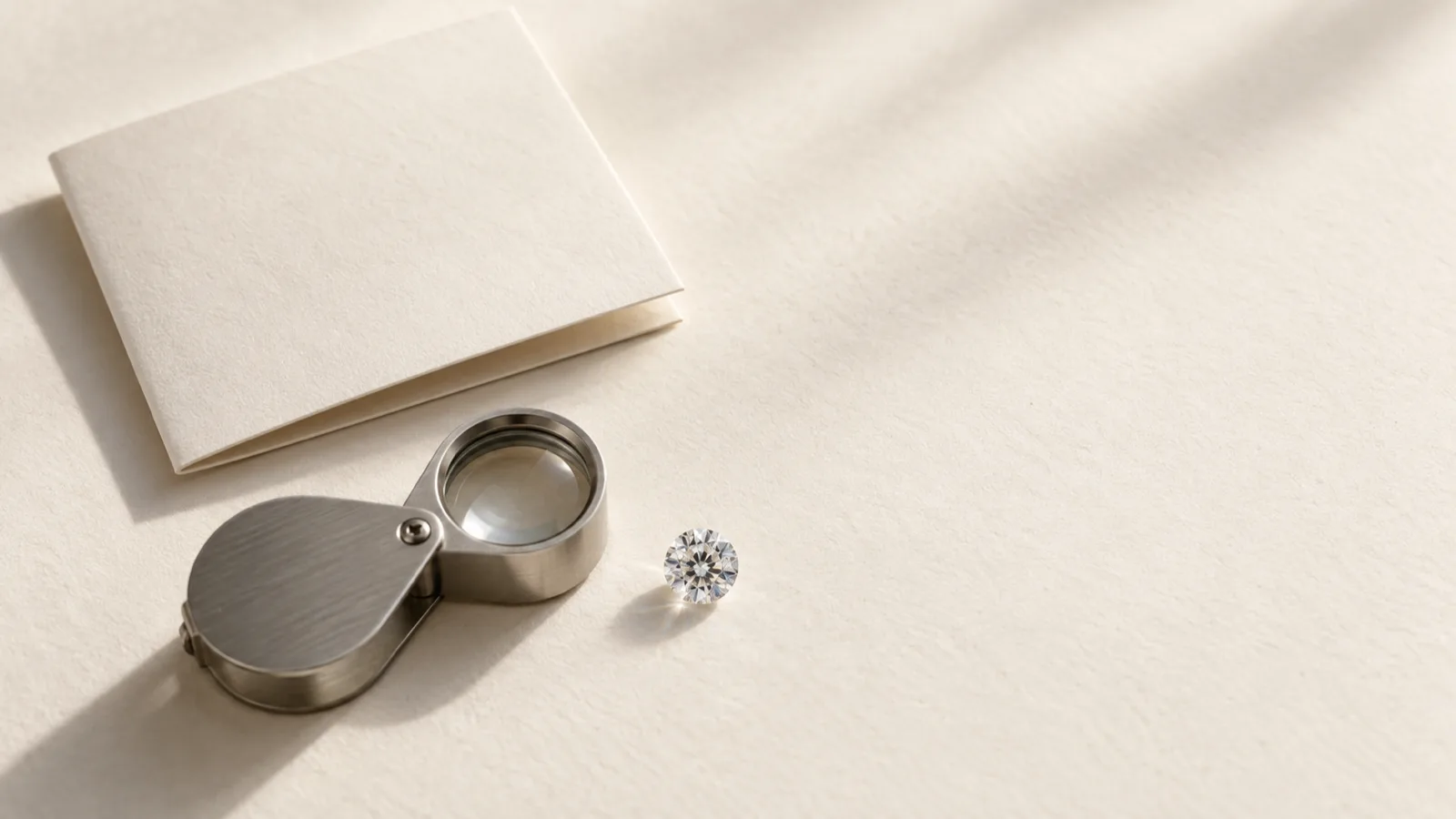
A loose stone lets you inspect more of it. You can look at it from the side and underneath and ask to view any laser inscription on the girdle under magnification. Once a diamond is set, prongs and metal hide some of it, and a GIA Diamond Grading Report describes the stone out of its setting.
That matters because GIA issues its Diamond Grading Reports only for loose stones.
Buying loose also lets you spend deliberately. Choosing the stone first lets you discuss a setting that suits its proportions and avoids committing to a ready-made ring you may not like. GIA points out that the setting can change the presentation of a diamond, so it's easier to match the setting to the stone than the other way round.
Where to shop for loose diamonds in New York
Each route below works well for the right buyer. None of them excuses a missing report.
On 47th Street
The Diamond District packs a great many sellers into a single block, and its business improvement district calls it the perfect place to comparison shop. The same guide advises you to ask about color, cut, carat weight, clarity and certification, and to ask why two prices differ.
The guide is also frank about the street itself. It warns about sidewalk "hawkers" who use aggressive tactics to steer you inside. It also mentions signs promising steep discounts or "wholesale to the public". The district says its closeness to manufacturers and dealers makes a better price likely, then adds that some deals may be too good to be true. If you want to know what "wholesale" means in practice, we've written about what wholesale really means for buyers.
At a jeweler
At an independent jeweler, ask for time to discuss the report and compare stones side by side. GIA's in-person checklist is worth taking with you:
- Ask whether the jeweler trained through a program such as GIA Graduate Gemologist or Applied Jewelry Professional.
- Ask for the GIA report, or ask to see only GIA-graded diamonds.
- Ask to be shown diamonds in your budget range.
- Look at each stone in different lighting before you decide.
Online from a New York jeweler
GIA's advice for online buyers is to browse only diamonds with a report from a reputable laboratory, to look for 360° views, and to read the return policy before you buy, because two diamonds with identical reports still look different.
Love & Carat is an online jeweler based in New York, with an office at 45 Rockefeller Plaza that doesn't take visitors. Every diamond we sell comes with a GIA or IGI grading report, and our returns policy is published in full. If you're shopping for a loose lab-grown diamond in New York, check its GIA or IGI grading report and verify any inscription against the corresponding documentation.
How to check the report and the inscription
Start with the report, then match the stone to it.
The report. GIA describes security features such as a hologram, security screen and microprint lines on its reports; for a GIA report, check its information against GIA's database. Its Report Check service lets you confirm that the report you've been given matches what GIA has on file. Every diamond GIA evaluates is cataloged with a report number that you can look up at any time. For an IGI report, ask the laboratory directly how to verify its details.
Know which report you're looking at. GIA's Diamond Dossier is a compact report for natural diamonds between 0.15 and 1.99 carats, and it has no plotted diagram. For natural diamonds, GIA's full Diamond Grading Report includes a plotted diagram of the stone's characteristics, which you can use alongside any inscription when checking the stone.
The inscription. Some graded diamonds have a laser inscription on the girdle; ask the seller to show it to you under magnification when present. For grown stones, GIA says every lab-grown diamond it evaluates is laser inscribed with "Laboratory-Grown" and a GIA assessment number. If the stone is inscribed and you can inspect it before paying, match its inscription to the report; otherwise, ask how to verify it on arrival and check the return policy.
If you already own a GIA-graded diamond and want it matched to its report by image, GIA says you can submit it for an Update Service to receive an updated report with an image that enables inscription matching.
Treatments. The 47th Street BID's buyer's guide, accessed September 30, 2026, says fracture filling is not permanent and describes disclosure as a condition of its legality; check current official consumer guidance for the rules that apply to your purchase. GIA says its Diamond Grading Report covers treatments along with the 4Cs; check the particular report's treatment disclosures before buying.
Which shapes and sizes give the most for the money?
This is where it's easy to overspend: on grades that look impressive on paper but are hard to see on a hand.
Put the money into cut. GIA calls cut one of the most obvious Cs to the untrained eye, because it drives brightness, scintillation and fire. We'd take an excellent cut in a lower color over a top color that's cut poorly.
Drop a color grade or two. The 47th Street BID's guide notes that grades G through J are "near colorless" but, if well cut and set in jewelry, look colorless to the untrained eye. That's the range where we usually steer people.
Buy eye-clean, not flawless. What matters to most wearers is whether you can see an inclusion without magnification. A stone that's eye-clean can look much the same on the hand as one graded higher, so compare them yourself before paying for the difference.
Don't fear fluorescence. GIA says 25% to 35% of the diamonds submitted to it show some fluorescence, and only 10% of those show enough to affect appearance. Every GIA Diamond Grading Report includes a fluorescence evaluation. Read it, look at the stone, and don't rule it out on the word alone.
Mind the size steps. According to the 47th Street BID, larger diamonds are more valuable per carat, so size can add to the price more than you'd expect. Compare stones on either side of a round-number weight; a slightly lighter one may look just as good on the hand.
Consider shape. Compare face-up dimensions as well as carat weight when considering an oval, pear or round. With an emerald cut, inspect the stone carefully for inclusions you can see without magnification.
Compare lab-grown with natural. The 47th Street BID describes lab-grown diamonds as chemically, physically, and optically identical to natural ones. Lab-grown diamonds usually cost less than comparable natural ones. Where the two look the same to you, we'll recommend the lab-grown stone and the lower price. You can browse center stones for engagement rings with those trade-offs in mind.
Getting it set, and insuring it while it's loose
Once you've chosen the stone, the setting is a separate job. Whoever sets it, a few habits protect you:
- If the stone is inscribed, note the inscription before handing it over and ask the setter whether it will be visible under magnification after setting.
- Ask the setter for a written intake receipt describing the stone by its grading report.
- Keep the report safe: it documents the diamond whether the stone is loose or set.
GIA reminds owners that diamonds are tough but can be chipped through impact or come loose in their settings. It recommends storing a diamond in the container your jeweler gives you. That applies twice over to a loose stone waiting for its setting.
Insurance. GIA advises buyers to have a diamond appraised and insured and notes that appraisers and insurers use grading reports. GIA doesn't perform appraisals, and neither do we. Your insurer may ask for an independent appraisal, and GIA notes that appraisal associations can help you find an appraiser near you. Ask your insurer what documents it needs and how it will value the stone, and follow its requirements. Diamonds are not investments, so don't insure one on the expectation of resale value.
Your receipt, sales tax and delivery
According to the 47th Street BID's buyer's guide, accessed September 30, 2026, these are the paperwork and refund rules it describes for Diamond District shoppers; check the relevant city agency for the rules that apply to your purchase:
- The BID says jewelry shoppers should receive a written sales slip showing the total, sales tax separately, the date, the merchant's name and address, and representations about the item, such as its grade, weight and color.
- The BID's guide says purchases over $75 call for a detailed receipt. The guide says a diamond receipt should include accurate grading and carat-weight information.
- The BID's guide says shoppers may be entitled to a refund within 20 days when a merchant has not posted a refund or exchange policy.
Rules change, so check the city's consumer protection agency for how they apply to your purchase today.
Sales tax. The 47th Street BID's guide, accessed September 30, 2026, describes sales tax as a separate line on a jewelry sales slip. For the current sales-tax rate and the rules for your delivery address, consult the state's official tax guidance; don't assume the rate from a seller's location. Our guide to New York sales tax on jewelry explains how it works.
Delivery. Our orders ship insured and signed for, from our partners in the US, the UK and elsewhere, and we pay the import duty on orders to the US. Orders to other countries may have duties or taxes collected on delivery when the stone crosses a border. Our shipping details cover the rest.
Wherever you buy, choose a graded diamond you like, keep a detailed receipt, and verify any inscription against its report.
Questions
Is it cheaper to buy a loose diamond and get it set?
Not automatically. Buying loose puts the money where you choose it: you can compare stones report against report and spend less on a grade the eye won't see. The total still depends on the stone, the setting and the labor.
Are diamonds cheaper in the NYC Diamond District?
The 47th Street BID says the district's closeness to manufacturers and dealers, and the competition, make a better price likely, and it warns in the same guide that some deals may be too good to be true. Compare like for like: same lab, same grades, same shape, and a written receipt.
Are diamonds worth more now than 20 years ago?
We don't give financial or investment advice, and we don't treat diamonds as investments. Buy a diamond because you love it. Nobody can promise what it will fetch if you sell it later.
Where can I buy affordable loose diamonds?
Compare certified diamonds at 47th Street jewelers, independent jewelers and online stores; check each report and the seller's terms before buying. Ask to see diamonds a grade or two below the top in color and clarity, and compare a lab-grown diamond with a natural one of the same grades. Lab-grown diamonds usually cost less than comparable natural ones.
How much does a loose diamond cost?
It depends on the four Cs and on whether the diamond is lab-grown or natural. Size matters too: the 47th Street BID notes that larger diamonds are more valuable per carat. Set a budget first, then ask to see the best-cut stones within it.
Sources
Nothing on this page is an appraisal or financial advice. Markdown version · RSS